but why does it make me cry

You have no real choice as to what to do.

You are going to hurt and cry.  That will happen.

No decisions can be made right now—grief does not make good decisions.

You will hurt and cry and second guess yourself.  You will be confused.

This all needs to happen.  

No decisions tonight.  You agreed on space, and that’s where you are. It hurts there.  It is not your permanent home.  I swear it is not.  I lived there for awhile, but I got free, and so will you.  

There are no decisions about what to do. Yo do have to go through this. You are loved and loving and your future is bright

If only, I think, someone had said these to me, these small things . These are really the only things I write well on, no once upon a life for me.

Easy

These dry words

crankled dry painful

Into my ears

just and only waves

nodding, I hear you

1-3 word limit

without wonder or surprise

that you both suffer

in your own time

I’m sorry

for all of us

even if I’m just

collateral damage

to the accumulated

expression of your

near indifference

your cold quiet gaze

and the yearning stillness

you have left me.

The First and Last by Iris Morton

We begin the walk 
Woodside to Stoney Brook
heading out our fledgling arms join,
inhaling each other
deep,  
our combined essence swirls on this atmospheric,
quintessential, 
autumn bright day.

In this moment we take pause, 
we breathe in all things pure 
giving honor to afternoon’s sun and her radiant shine

Trying to always remember
we choose granite stones 
laying the sacred labyrinth
at nature’s center,
untapped maple reach for sassafras hickory and hard wood oak,
fresh moss mounds open from the breeze of dragonfly wings,
Honeybee offer their comb and iridescent hummingbirds whiz about in celebration.
Drips of nectar find our lips.

Gazing up for this glory 
green eyes of glass,
our backdrop hovers 
in brief possession 
of forget me not blue.

Still unknowing of
our own direction
second life for first loves
found this time in a Devil’s Hopyard,
slow sure strides 
setting the pace, 
gathering trust 
in each other’s sure footedness.

Sylvan Hill, 
witness to the swell
our wave remains 
to and for only, 
us.

Countless burnt orange
crimson rust and golden amber drops 
all in the process of loosing their value
focus stays on 
our fading gifts from father sky
this is a path we dutifully follow 
in determination 
our unison gait 
plows through 
attentively mixing the painters pallet.

Dusk 
gingerly peers in
damp with tears 
it’s the moment to tip toe 
over the made up line
an intrusive and oversize 
STOP, 
marks our parting
candy apple red 
shocking 
graffiti spray spits,
out of context 
nonsense.

Ash tree on the corner
a trickster 
seductively leaning, luring 
seemly heathy 
but infested with deadly emerald borer,
her partner Elm
reigns above rotten roots
shedding branches on fresh paved asphalt,
delicate flat leaves  
shaped of lemons 
hold serrated edges rounding every last curve.

Unable to see the spot in which we started 
night abducts us 
and we recoil 
Holiday Drive
I fall numb
and ungrounded.

From now until April 
it’s slow motion 
blows 
backlash
distant echoes 
going through 
being through.
Walking home alone
not alone
far away
I can 
and I do 
still hear
quite you.

A Gift of St. Patrick’s Day

A gift of St. Patrick’s day                            

It must have taken several attempts for my landlady to bang hard enough for me to recognize her summons as something other than the ongoing howls and thumps of the early spring storm seething through the neighborhood.  I had just returned from the corner store, having picked up the requisite diet soda and cigarettes. The hood of my car, nosed up to the tree standing like a column at drive way’s end, was probably still hot from the trip, despite the cold rain driven to earth at angles anything but perpendicular to the muddy minefield her dogs and chickens made of the yard.

It was St. Patrick’s day, ten years ago, and the soda, cigarettes and backlit e-book were the sole ingredients of any celebration I’d be having.  The wind had taken out the power about an hour before I went out for supplies to fuel my solitary party. I don’t remember what I was reading, but probably something about god or belief or how and why it is that we come to those understandings.  

The noise of the storm and my own alarm at the unexpected visit acted together in a way that has obscured most of the content of her message.  Words poured from her darkened face in the unlit entryway outside my front door. What I understood and remember only dimly now was that she was very sorry about what had happened, about what the storm had done. 

I know that I told her not to worry, that the loss of power didn’t concern me that night. I was content to ride it out, sipping soda and peering into the glow of my little, battery-powered screen. I must have smiled and waved it all off.  That makes sense. She said something about my car, her face obscured, her words indistinct and diminished by the insistent storm.

Then she asked whether I’d been outside.  No other memory of my interaction with her that night survives.  She went her way, and I went back out into the wailing, windy world outside our doors.  I think she chose to make herself scarce. The streetlights hung dark and useless on their poles, and it took several steps from the porch for me to see the storm’s windfall in my life.

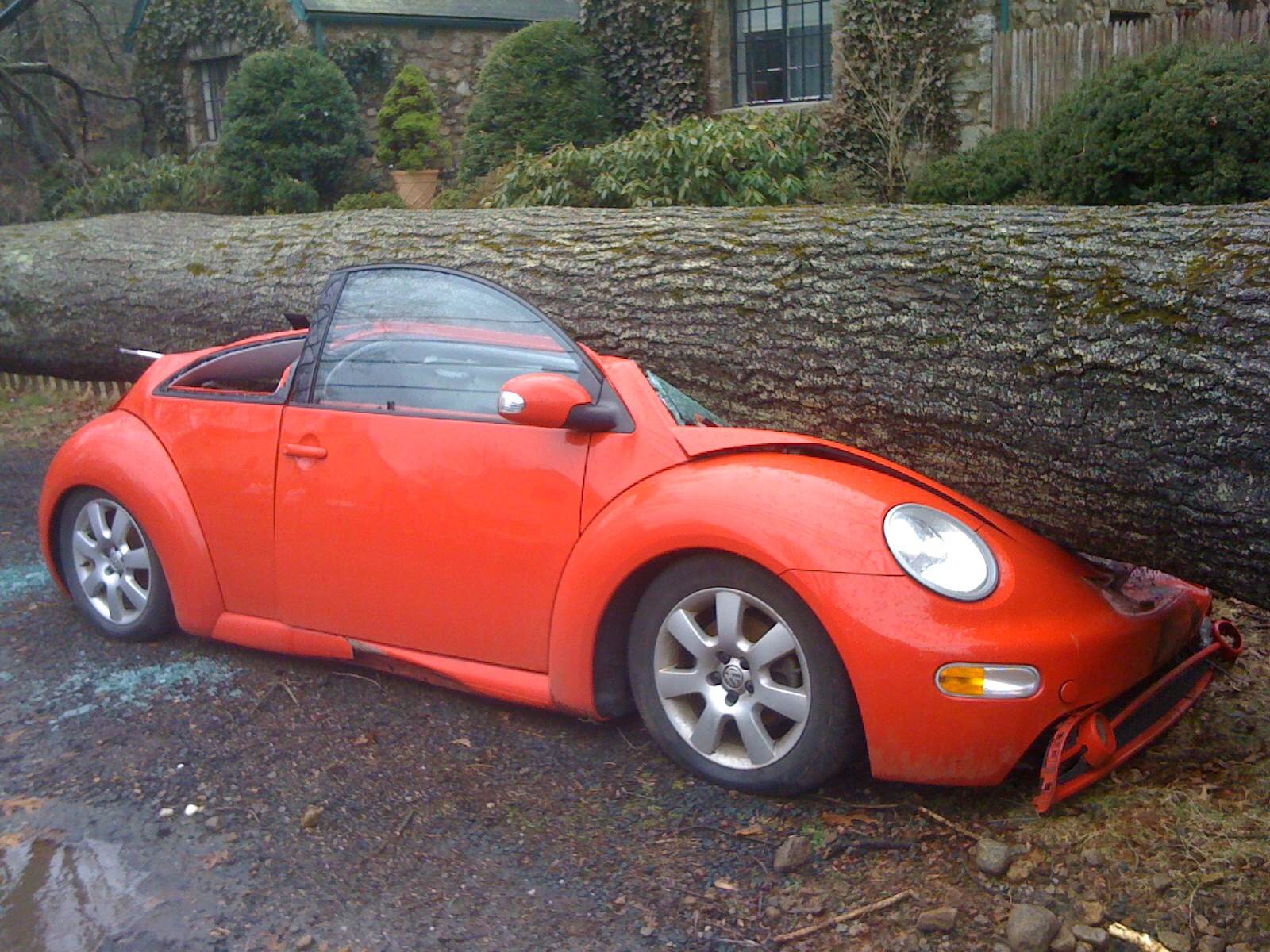
I always parked there next to the tree, parallel to the little street, as there was no room in the driveway for two cars.  The white oak fell right down the middle, crushing my VW Bug lengthwise. Enough room remained on each side of the rough trunk such that, while both the front and rear windows were smashed, the glass of the door windows on each side of the car stood whole and uncracked.  I pulled out some jackets, some CDs and whatever else I could reach and find around the tree’s bulk. The rain soaked me through and I went back to my bed, dropping my sodden pile of recovered items just inside the front door.

I don’t know who I called first, probably my younger brother Pete in Phoenix.  I’m sure I sobbed, feeling as though my new bad was definitely worse. After we hung up, Pete surely called my brother Sean, who lived about half an hour’s drive from my Norwalk apartment.  I learned from Pete that Sean was coming to pick me up so that I could stay at his family’s house that night. I called Pete again, angry and overwhelmed. I did not want to see Sean. I did not want to go anywhere at all.  Not with him.

After 12 years in Orlando, I had moved back to southwestern Connecticut, my childhood home, to help Sean run a business there.  It was a new venture, and all of my old ones in Florida had disappeared, failed or been taken away. At the time, the move and the job had seemed like salvation.  I cried tears of relief in my sister’s kitchen in Cranston when Sean first asked me to come work with him. After six back surgeries, a job I’d lost after all the sick time that followed, a marriage then in separation, the door Sean opened looked both promising and singular.  No other options were clear, and my thinking, after repeated and sustained loss, was anything but.

Before I’d even closed the passenger door of his car, Sean pulled a burning pipe from his mouth and shoved it into my face.  I smoked a little and handed it back, watching him goose the gas with his right toe while his heel kept pressure on the brake.  This was only necessary when the clutch was depressed at a stop. His car was always on the verge of a stall. It’s just the way he ran things.  Still does I figure. His primary motivation for picking me up that night was the chance it gave him to get out of the house and get high. I understand that now.  I should have known then. I should have stayed home with my crushed car.

The ride to Sean’s house in Brookfield was uneventful save the need to avoid a few downed branches on the quieter back roads.  He didn’t speak much to me, but we’d moved away from small talk in our relationship months before. We communicated only as needed, which sometimes meant I’d leave notes on his desk at work, and that I’d wear headphones and listen to podcasts, anything really other than him as I methodically moved around in the grunt work he seemed incapable of seeing, let alone doing.  

His daughters were already in bed when we got back to his house.  His wife Annie was up, and she made me a plate of food that we took into the TV room so that I could sit and eat.  And stop, and breathe. I don’t remember what was on, just as I don’t recall really what it is we all talked about.  I was in a daze that had little to do with marijuana.

Eventually. Sean went back to their bedroom and disappeared for the night.  Annie and I stayed there on the couch while the final stones of the dam holding back the flood in my psyche washed away in that St. Patrick’s day storm.  I spilled it all: Sean’s habits with money, the bounced checks, the little straws I found on his desk after a locked door session with his “friend” (read: drug dealer), the near constant marijuana use, the horrifying work ethic, the inequity in our work roles, all of it.  I was tired, in pain and broken. My world had been smashed through once again.

We gave up, both of us, soon after my revelations and each went to our beds.  Mine was a blanket on the floor of the girls’ playroom upstairs. Accordingly I woke up early, though the girls were already up and gone to school.  I made calls to my insurance company, to my landlady, to my parents. For no reason at all, I decided that I needed to be back with my car, so we drank some coffee and off we went, back into the bright, post-storm day.

Many leaves and branches covered the roads and roofs of houses and cars.  I was in no state to notice, but my sister in law must have been acting strangely because Sean asked a couple of times what had been discussed after he went to bed.  Neither Annie nor I made direct response to this, and we proceeded as I had become used to when spending time with my brother, in silence. It could have been five minutes or two hours, it was all the same to me.  I just wanted to be apart from my brother.

They had their moment marvelling at the tree trunk splitting my car down the middle, then left quickly without entering my house.  I stayed out a little longer, reaching into the crushed cabin to see what else I could reach and rescue. It occurred to me, for the first time, how lucky I had been.  Imagine the fallen trunk, horizontally splayed on my car, as the hour hand on a clock face, marking the time as 12:00.

A wind shift, a power line, even another tree might have pushed the tree’s final hour to almost any time.  It would only have to have fallen about 60 degrees from where it did, to the hour of 2:00, for that trunk to have come right through the slate roof under which I lay quietly sprawled in bed, reading in the dark.  It might have happened as I pulled the emergency brake after picking up my soda and cigarettes. The root ball, such as it was, looked like it could have fit comfortably in the trunk of a car.

I left town that day, or the day after.  I’m no longer sure. My parents came to pick me up and take me back to their place in Rhode Island.  It was a rescue mission. At the time, it had seemed like a temporary measure, some breathing space while I figured out transportation and my life.  My phone rang steadily, my brother at the other end, over the next several days. We did not talk. I wasn’t really talking to anyone, certainly not him.  I knew what I had done.

When we finally did talk, I had already moved out of my Connecticut apartment, and moved on from being a partner to Sean in anything.  The most important thing he had to ask me was why I had not come to him first to ask what was going on, instead of dumping it in his wife’s lap.  My only answer, still, is that I shouldn’t have been in a position to have to talk to anyone about anything. I was angry and resentful. I carry some of that still.

The important part, for me, is not how I reacted to a brother sliding off the edge into heavy drug abuse, but that I had a brother who was flirting with death, abusing my trust, mistreating his family, treating me like an indentured servant and generally acting like an asshole.  He never considered that all those podcasts in my ears were less about learning than about blocking him out. Smashed car or not, the system we’d built and adapted to was incready unstable. Just the puff of wind accompanying my words to his wife had been enough to bring it, and all of us, down.

Lots has happened since then, though Sean and I still have no relationship.  Three years later, after my brother in law’s very unexpected death, Sean arrived half an hour late to the post-wake dinner.  He sat across from my parents, my sister the widow and a parish priest and proceeded to nearly nod out at the dinner table. His eyes rolled back in his head.  He lost his place in the middle of sentences. Even small children at surrounding tables took note of the oddness no one was talking about.

Clearly his trip back to Connecticut that morning was a resupply trip, and he was well into his own party throughout the two days the funeral and all the accompanying events took up.  (He’d siphoned gas out of three cars in my parents’ driveway to fuel his drug run.) There was yelling and ignoring and brief, huddled talks in quiet corners. The morning after the wake, hours before the funeral, I asked someone if he thought it would be a good idea for me to confront Sean and make him give me the drugs.  I got laughed at.

My brother in law still has no stone to mark his burial site.  Too much for my sister to face. I doubt she’s even been out there, but it’s sure not my place to tell others how to mourn.  Soon after the burial, we intervened on my brother, and we prodded him along to a rehabilitation center. He left halfway through the program, burning some more parental cash.  I’m on my second car since then, though both were used when I got them. My mother’s cancer came back, and Sean stole some forty plus narcotic pain pills from her a couple of months ago.  I guess the week’s supply in the opiate patch he’d left behind on the rug in my parent’s spare room had crapped out.

Sometimes, when a horrible thing happens, it is like the expansive, exuberant and brilliant finale of a fireworks show.  Lots of little blooms with different illuminations and sounds, then the over-the-top extravaganza with too much sound, more shapes and colors than can be counted.  Then silence and drifting smoke as people pack up the blankets and we ooh and ahh our way back to the parking lot. There is a clear ending, and a time to go home and get ready to try again tomorrow.  

I wish I had been able to hear the sound of that tree trashing my car.  It was, after all, the finale to a part of my life I look back on with horror.  It gave me an out, one which I happily took. The pops and bangs of my brother’s ongoing addiction still sometimes give me a start, because that show is far from over. 

As with such things, the ending will more likely be marked by fizzling and whimpers, but I refuse to be a part of that story anymore. The business failed, Sean’s wife divorced him, his new car was repossessed, he’s lost more jobs than I can count, and he now has less than three months before the bank takes his house.  My family members are still oohing and ahhing, and Sean is still an addict.

But that oak tree saved me, and I’m grateful.  My friend (now my wife) thought at the time that the tree would indeed produce positive changes in my life.  She knew of some of my struggles, with my brother, my health and my past. Though the details were a little off, she was right about those changes.  My life with her now, in our house, is joy. I had no faith in god or karma or any sort of comeuppance when I lost that car. Now I know, and I know better.
greens that wither

behind the welter of

summer leaves green

the fragile jagged limbs

of hanging winter lurk.

I feel them stalking there

in the creak and crackle 

of aging joint and bone

erosion.  The road’s turn

sidles continuously away

as hair goes snowy 

falling to my feet.

Cold time again with

its struggle to raise 

my head and greet pain.

Warmth is still in me

radiating out less an

inch or two as skin scales

over preparing to tear.

Leaves will come again, again

a matter of weeks in

their lonely, stolid years.

The twist and twine

of slow-moving vine

tie them together,

green shapes conjoined,

until the slowest time

when the creeping vine

has tied them tight

to choke them out.

The leaves shall wither and

fall, pooling at the 

straight edges with which

we gird and grid our lives.

There is no security

in the vines and lines

that link us all.

it is we, growing every which

way.  We are pulled together

and hold our lives

warming our world

binding us to that which

is safe, and loved,  and connected,

and impossibly old.

The Rest

An inward-curling shame

greets the idea as I rinse

dripping soap from my frame

I want people to cry 

when they hear I have died

no need for rending or gnashing

just quiet, resigned drops

falling on faces, hands

I think those tears will work

I towel between my 

toes, displeased with the hairs

and dust gathered on the

toilet’s shiny white base

I scrape away with fingers

and the towel’s edge, finished

with my ever-fading

body and bones.  I’ve given

so little cause for them, the

tears.I want them falling

as my little drop

rejoins the larger stream

When they come too, all the

weepers, I will still be

all wet, coursing the sea

of the tears of us all.

Regenerate

adrift in personal history

dead days gathering

against the borders 

of the miracle now.

lost both to future and past,

tense as a plucked string

thrashing its note into air

phoenix breathes deeply into 

yesterday, and with a hitch

and quiver, into tomorrow

past ephemerality

into blinding promise.

the past just a pile of

haphazarded rubble, 

only inevitable in repose.

sirens of tomorrow

call and promise

wait, they tell me, 

nerves grow back

like fingernails,

bitten bloody, measurable

only in words and waiting.

cauterized sentiments

still sensitive to touch,

the pulse of right now,

demanding breath and notice

and impossible attention

I’m here and trembling

in bright now.

Wanted: Friend

I last saw Robert the evening he joined us for dinner at our house.  It wasn’t the first invitation that took. He’d once texted twenty minutes before his scheduled arrival that he had to beg off because of his peaking anxiety at the prospect of sharing dinner with me and my wife. It was disappointing and a little confusing, though ultimately understandable and forgivable. We invited again.

Robert can best be described as eccentric–the type of man who clothes himself in thrift store finery and fedoras.  He didn’t always smell so good, even beyond the persistent ashtray smell of the cigarettes he smoked. Less kind observers might note that he showered himself and cleaned his clothes far less often than seemed necessary.  The words “smelly weirdo” might be used by the least kind of us.

Through this fog of hygiene habits shone a persnickety intelligence that marked every interaction with him that I either experienced or witnessed. I can only hope my own brightness shines so strongly.  My weirdness surely blinds some to whatever else might come from me.

From our first meeting, I had viewed Robert as a potential friend, quirks or no.  He is smart and funny, and I saw in him, too, some of the hauntedness that I carry.  I don’t have many friends. Beyond some of my siblings and my wife, none really.

I look forward to making some in this fifth decade of my life, and I certainly hoped to change Robert from a guy who chatted and laughed with me while at work into a person I could call in crisis, or just for a movie, or to share life’s joys and sorrows, or just some food over a midday meal.

When he finally came, the dinner Iris made was wonderful and we all got along, laughing and talking as we ate.  Still, Robert seemed nervous, but that behavior was consistent with what I’d seen from him in the workplace where we’d first met.  It’s easy to forgive foibles one shares.

Iris and I each ate some of the awful BigY dessert Robert brought after we’d all settled into the living room’s comfort.  The remainder of the sticky, store bought chocolate treat was thrown out as soon as he drove away that night. It was kind of him to have brought it.

We talked and our evening progressed.  We watched some comedy on television and shared some laughter at the silly narcissists bouncing around the screen. It was the most demonstrative I’d ever seen Robert, being more used to his somewhat serious and engaged manner in the workplace.  He was the sort of guy who ensconced at his desk, surrounded by piles of paperwork, hunched behind his keyboard and monitor.

I learned that I was right about that ghost I thought was plaguing Robert.  He fleshed out the details of his difficult childhood–beatings and emotional privation in his years as an only child.  His later choices in adulthood, his time as a devotee of Vicodin and vodka, did not entirely surprise me.

I found myself happy that he’d come through that period seeming whole, working a good job and making a way in the world.  By lots of objective measures, Robert was successful. We did not serve any alcohol, nor did he request it. That was fine.

At the door, Robert hugged me on his way out into the winter cold.  He did so with a fervency I’d normally associate with reunion of long-lost relatives.  I could smell the cigarettes and his different standards of personal care as he clung to and thanked me. Then he was gone.

I had emailed Robert a couple of times in what wound up being a couple of years.  Brief, even one-word replies were all I got back, friendly and prompt as they sometimes were. I had left the job that united us months before we shared that dinner. As mentioned, friends are scarce in my life and world.  I lack the knowledge of the logistics and frequency of contact so necessary to building relationships. So we drifted, each our own way.

Life went on.  We moved. I had several operations to fix my crumbling bones.  I spent a lot of time at home with my wife, much of it horizontal on our mattress. Not even family really visited, at least not from my family.  I began to think of Robert again, and friendship. I sought Robert. I knew from checking the website of my former employer that Robert, too, had become “former”, and I had no sense of where he had gone.

Consistent with my social reticence, I did not call our old employer to ask after him.  I had only his old work e-mail, and a phone number for him that told me only that it was no longer in service.  I did what all of us do then–I asked the internet where my kind-of friend could be found. I learned just exactly how haunted my would-be friend is, and ever was.

Robert had turned himself in on the active warrant in his name and was arrested in Connecticut, hours from where we’d worked together. He’d been living in the same town in which I’d grown up, having landed a quite good job at a town institution. His address, as listed in several of the news reports posted to the web, was on the same street as a long-term family friend.  I had ridden bikes on the street, played capture the flag across its yards.

Let me tell you why this matters.

I was multiply, serially, sexually abused as a child, from maybe age four to age eleven.  By relatives, but then, also, not-relatives. My family, my neighborhood, my school, my church acted in concert to squelch and stop my voice, on this subject and many, many others.  I learned to live in suspicion, distrust and uncertainty. I learned to doubt everyone, including myself. I’ve always known. Always. I could not talk about any of it, even to myself.

Statistically, there was strong probability for me to have turned out quite differntly than I did–incapacitated, imprisoned, interred.  My neighborhood of the flies, where I was almost drowned by others, hit in the face with a 2×4, tortured and teased, would have been more than enough to strangle my trust and twist my psyche.

But then, the other stuff, the manipulation and coercion, the brutality, nakedness and disregard. All this happened, it was real and happened to my and I can finally acknowledge it. That place, those people, formed who I am and was.

So see me, Catholic school boy, biking and playing near my friend’s on Crooked Mile Road.  Robert lived on that street when his arrest warrant was issued, seeking him for obsecentiy, promoting a minor in obscene performance and illegal possession of 45 images of child pornography. These images were found across various digital devices he owned. He turned himself in, ultimately. I don’t know even how he knew to do so. At arraignment, he pled not guilty.

He seemed far more forthcoming at time of arrest, at least according to news posted to the web, admitting to a long-term obsession with sexualized images of children, claiming never to have acted upon his fantasies, seeking assistance from AA.  One source cited his own self-destructive ideation at time of arrest. He knew his life was over, they tell us, regardless of conviction or sentence, because of the nature of his profession and the severity of the charges.

The images accompanying these stories reveal a doomed-looking man, a person in deep despair, standing in a courtroom with a lawyer.  One article also notes the grim faces of his parents behind him. I think perpetrators of all sorts should despair in trial settings.  After his plea, I can find nothing more of his legal story on the internet, though that court date was almost a year ago.

I am not sure what I would say to Robert now, if I even knew how to reach him.  That I played in the streets as a boy where he lately lived. That I understand despair.  That my childhood was no paradise, either. None of these things really suffice, alone or in combination, to encompass the welter of feelings that greeted my discovery of his offenses.

I understand now, though, why no real friendship developed between us.  It could not have. His secrets were deep, ugly and shameful. Mine too.  He really decided for us both that the strands of our lives would never be entwined.  I thank him for this mercy.

He kept me ignorant of the damning choices he had made.  Some grace kept me from similar decisions, if not the shame from the choices others made for me.  I never imposed my ghosts on others. I would give him some of what I have, that grace, if I could. God will need to be the intermediary.

Stock Phrase Here

It was not a strategy or habit that I consciously cultivated. Certainly, it would have served me well in most any situation—home, school, practice, church or just trying to remain tearless and unbruised in the rough and beat-on neighborhood of my primary years. It’s all about avoidance, safety and the ability, the right even, to simply disappear. No tears, well wishes, hugs or insincerity, and most importantly, none of the rote words attempting to convey emotions not truly felt—or, even worse, real and difficult feelings overwhelming me.

It was after the final performance of the play I was in junior year of college that the fear of pain, of loss, prompted me to disappear from the cast party and stage breakdown. Usually on the periphery anyway, the fade away I practice is far too easy to perpetrate.

In my birth family, it’s known as the “Irish exit”, though I’ve heard it called “French exit” in other quarters. Falling where I do in the family, sequentially, temperamentally, I almost certainly am better at it, though my older sister Katie must come close to my skill level.

If I could consistently make it happen, I’d practice the Irish entrance as well. As you may have guessed, sneaking into an event is far harder than getting out unseen. Even parking down the street, using the back door, silently merging with others leaves one open to inquisition. It can be very helpful to carry something in, even a full bladder (pretend as needed, with a hunch over and hand on belly button) to avoid perfunctory questions and practiced answers.

Furtive, frightened, perhaps maladjusted—all of these are likely apt descriptions for a leaver like me. I was actually a performer in that play preceding that cast party. That was I onstage, reciting my lines, acting as expected, as directed. That exposure I can manage—on stage, I knew just what to do and say. Stage direction and script came included. No matter how often I run lines in my head to deal with the impromptu nature of human interaction, the other actors on my life’s stage insist on ad libs.

I can’t stand the whispered, boozy confidences, the overwrought and held-too-long hugs. The pretenses of let’s get together and it was sooo wonderful to see you wore thin for me even before I understood such stock phrases for what they are. I’ve heard such film-flam from my own mouth.

What I failed to learn is that, in the thickets of flattery and falsehood, flowers also grow—that some people truly are pleased to see me. Sometimes words, actions and emotion align. Among those few whose words are true, whose warmth is real. I am becoming aware that such people exist, and they enter by the front door. I’d like to meet them more often, and my sudden arrivals and departures can not help. Ad libbing, telling the truth, staying silent as needed—these I can do.

It was so nice seeing you! See you next week—looking forward to it!

Traum/ASDF

hung on still air

like a speckled

flock, thick, floating

waiting on just

a touch, new life

in a moment

unguarded, still

again, alone

fingers loose, arched

like cats, on keys

worn with use, ranged

before me, eager,

ready to live

a page in dream

chance lost to fear

begin now, press

push into them

and make them dance,

fly, forever

a name, just words,

lines in a face

words on the page,

waiting on me.

Bones Broken/

Since I spread rolls of insulation in the attic after moving in, I’ve known the sub-standard quality of the materials used in constructing the roof of this house. Armed with breathing protection, a miner’s head-lamp and cumbersome rubber gloves, I spent hours pulling, pushing, coaxing the long pink strips into place between ceiling rafters. Each time I removed the gloves for a break, sweat dripped from the sleeves. The cone of the breather collected brown dust over my nostrils and mouth.

Long 2″x 4″ boards bowed under the pressure of heat and years. I felt the curves of them while taking brief breaks. I knew that at some point in my stay, there would be work done up there. My back panged and sang as I clambered around on the rafters, shifting the small plywood platform I knelt on to work. Even at the peak, only a child might stand upright in the space, so I’d just sit to break as I eyed the long curves where only straight should have been.

That was all done right after move in, and except for some brief visits to place mounts for ceiling fans, I’d not spent much time up in there. Beyond the confinement of the place, there was the fear it inspired. Between us and the world, just this small shield of wood, tar and paper. At each rain fall, I’d envision first a small spot of wet in the plywood, then the drip into boxes of magazines or clothes and the spreading brown stains in the ceilings above beds and heads. All the slow-motion horror of decay.

Then my back failed, in what felt like fast-forward. Home improvements became less important. Some money came of my decay between operations four and five and my mind fixed again on the way of things, the crumbling and degeneration. Sticks and bones break on their own and minds go crumbling after. We found a contractor to replace the roof, and a radiologist to inject my spine. It felt like progress and not just fingers in the dike.

In the midst of removing the old materials, the contractor discovered many problems in the structure: the framing was weak and inadequate, the plywood was brittle, destroyed by the heat of Florida sun–all needed replacement. So it began and progressed, from pallets of plywood dumped in the yard, to the cigarette butts of workers curled in the sand of the driveway. In the midst of it all, with me on a hospital bed, one foot came through the bedroom ceiling, and bits of trim came to rest all over the yard.

All is fixed now–new shingles and plywood on 2″ x 6″. More titanium screwed into the bits of bone in the middle of me. Some cigarette butts are still out there, and nails strewn about. Apparently, the magnetic clean-up of the yard promised in the contract was either neglected or ineffective. It wouldn’t have touched the cigarettes.

For me, there is a walking cane, a brace for support and the place they cut patched with strips of tape. It is still a bit bloody and bruised. I discovered after another fusion that the titanium does not set off airport metal-detectors. It is, perhaps, not even magnetic. I read yesterday that some people return fully to normal activities after fusion, to Olympic competition, even.

I welcome rain now. The world is awfully dry, just awaiting sink-holes and forest fires.

From Subject to Objection

Little warns of an arrival, neither blush of skin nor vision blur but out from my mouth sharp words like shards of chewed glass. I’m still in here, I realize each time.

No internal censor, blocking words that cut. Gone is the guiding sense to do no harm. Only later can I look inside, to step along the path to the precipice where I scream into void. This happens more often now, the poison expulsion, the guilty introspection, often when I am alone.

I rail at myself, the frailty and foolishness, the mortality and introversion of me. I know no cure for this dissociation that makes of me the second person, the target of “you’re so stupid”.

Knowing seconds later that neither you nor I deserve such abuse, backwards I step along the path, away from the edge, back to the place where I am no longer you.

Push

I stare into darkness from my narrow bed hearing the sound of tire spin on slick streets. Waiting for sleep with the maddeningly random radiator tick, I forget the more regular, far too fast, beating of my heart. I catch myself not taking breath, place my left hand on my diaphragm to be certain of a calming movement there. Four seconds in four seconds out. I place the palm and fingers of my right hand on top of my skull, seeking its shape, keeping everything in place. My eyes pick out the outline of shaded windows, glowing clock-face and television tube, their lines and curves, keeping time alive, clear and persistent.

I seek out corners where there is no reminder of day, points of darkness and absence. I stare into them, leaning in, as if a strong wind pushed my thoughts. Lack of light, of time, makes patterns–bursts and swirls, ovals and long shapes not seen open-eyed—ill-defined, purple and redblack. They spin and jump in groups, like dancers from another ballroomed century, then fall still as everything will. Others take flight then fall as well.

With the balls of my thumbs, I press lightly on my eye lids. My face must look as if I am in a sandstorm–eyes squinting and clenched jaw with lips tight and prim. To see just anything, over time, blind kids end up beating at their eyes with fists. Many must be restrained. We need something to see, even just the light of nerves and pain. I push again, harder, just to the edge of hurts. Pictures return to blow and dance before slipping left, right out of reach again.

I stare into what is missing—my future, the fog and smoke of plans and wanting. My years fall away. My eyes tear with stress, so the patterns do split and multiply. I rock my head left/right, eyes squeezed tight. It is all there in front of me everyway. Up ahead, my eyes, mind, of all things my need to see, they make the dance. I want to take the hard sharp edges of tomorrow days and my unformed dreams and push them down, hard into my mind to find the axis of unfulfilled desire, to see how pretty what could be.

How We Learn

There were nuns at Assumption School during my primary years, though fewer with each passing year, just like at my formerly Catholic college. Some wore habits, different than those of my lay teachers in second, fourth and sixth grade. None wore pants, or anything but bland, modest, mono color skits and sweaters. Veils and prominent crucifix necklaces for everyone. The convent next to the church lot must have been progressively drab and persistently lonely.

My odd numbered years were taught by nuns. I’d like to think there was design in that. In first grade, after an unexpectedly rocky start in public school kindergarten, Sister Rosemary sat behind the teacher’s desk on my entrance to parochial school, all of us in our costume. She taught letters and words, numbers, addition. I learned something else too. How to lie. That I learned on my own, very early in the school year. Sr. Rosemary taught lots of things, but the lesson on lying didn’t come until the day before summer.

Sister’d started our first week with letters printed on perforated manila folder-type paper. Under fierce religious control, we were permitted to tear the letters, row by folded-over row. Fold and separate. Multiple copies of each letter were needed. Then folding, ripping some more, building alphabet collections to last the year. We began writing immediately, typesetting our names and the school’s on our desktops, Sister pinballed from desk to desk dispensing prim guidance. It couldn’t have been more difficult than our names, perhaps something simpler. I knew I didn’t have to bother completing the task, can’t say how. So I didn’t.

While I swirled the letters around the wooden desktop, Sister visited my small desk eventually. There may have been a sort of smile as she told me I could return my letters to the box. As far as she was concerned, I’d completed my letter arrangements. She conveyed her sense that I already knew just how to do what she’d asked. I did not disabuse her of that understanding. I was reading before Labor Day that year, certainly, but still, lie of omission. I knew how to spell, and sin. I was a front row kid, with three siblings at Assumption. Sister assumed much. I did learn deceit, even if I couldn’t have spelled it at the time.

Sister Rosemary’s lie, at least the first one I identified, came during our last week at grade one. Parents hovered, mysterious and silent in our classroom one hot day. We played a game very new to us prospective second graders–a once-only entertainment. With some fanfare, crepe paper glued to a brown box style, Sister announced her need for some help in the next school year. The paper slips she pulled from a small box contained the names of two students who’d help Sister in the fall. Or, at least, there were slips of paper, two names, a box and one big lie.

The parents maneuvered the winners out of the room quietly, immediately. Lisa Halas, one of the two, had only a mother there. I found Lisa again in high school. I hadn’t seen her since she’d won her prize that afternoon some ten years earlier. Lisa was again in the same year as I, so the holding back hadn’t held. We never spoke or even met eyes in three years. She did not join me in graduating. I’m not sure she remembered me.

The confusion created by these special prizes and parents, the excitement and strangeness of it wasn’t something we could question. We didn’t, anyway, and some even complained, wanting to be teacher’s helpers as well. At home, my mother explained something about these anomalies–the no-father family. And the girls, how they were smart, but only enough to have to take first grade twice. Mom let me in on the lie. Because I actually could have spelled out any of the words asked of me and my manila alphabet, I didn’t feel guilt then or now. I’d rather a child lie to an adult, a nun even, than a nun to torture and manipulate any child. I’d learned the trick-a-nun lesson all by myself.

I remember Lisa’s name because of the special role she played in teaching another crucial first grade lesson. There was a toilet in our classroom in a small windowless room at the back. We were children, after all, but pupils were to raise their hands and ask to go. Suffer them to go unto god, not unto themselves. Lisa blithely failed to live up to first-grade expectations. She broke the rules doubly even–she had not raised her hand to discuss the urine running down her leg. Who knows how long the puddle under Lisa’s chair was there, calmly radiating out onto dismal grey tiles. Seconds, minutes, but not hours–Rosemary was attentive.

I don’t think even a moment passed between the nun’s understanding of the situation and her vocal condemnation of it. Sister spat words at Lisa in the interim between the religious woman’s first step toward the girl and the moment both of them, connected, disappeared behind the bathroom door. From the pebbled glass in the door’s top half came only Lisa’s wordless muffled sobs and the much louder, sing-songy reproach flowing from our Sister.

A mop bucket preceded them out of the bathroom, Rosemary steering with her right hand on the mop’s handle, left hand buried somewhere near the neck in the Lisa’s hair and clothes. Each, everything, landed at The girl’s desk. I don’t know that desks and chairs near the puddle scraped away, even unconsciously, under the power of the students whose desks bordered the you-can-smell-it-too problem. It’s understandable if they did. It’s just reflexive.

Again, mercifully again, the details of the mopping and squeezing, sounds of drops on galvanized metal, are not part of it in my mind. They resounded though, those drops. For Lisa and all of us. Lisa certainly would have finished the job, and there’s the lesson in it, at least for me. See things through, and avoid any and all eliminative functions when at Assumption School. The troubling consequences of this lesson manifested for me first in Sister Catherine’s grade three classroom. Doctor’s visit was required that time. We were just kids, after all.

Found & Lost

I yanked it from the dream like a stubborn weed and emerged to morning half-sleep in triumph–25, 36, 47. As I rolled around and came to myself, I fought to remember, to take the code with me into the day. It was vital, somehow.

For me it isn’t the comeuppance of final exams after no study, or of finding myself naked in front of a packed assembly. My sweated dreams find me standing at a bank of tall, grey lockers in a high school hallway impossibly long. With my books trapped inside and class looming, I stand spinning the dial right left right to no effect. I have no destination, but a deadline looms. No bell rings, I know I am late. No-one surrounds me. I find an office and see only faceless bureaucrats behind walls of glass, and blank, yawning monitors on desks, most of whose chairs are empty.

But then, in a dream colored by the drugs that now only half work for the pain, my locker opens, finally. It’s easy–25, 36, 47–right left right, open it swings. A breakthrough. In my twilight state, I exult. Alone still, I crouched at the open door. Left-behind things litter the locker’s floor, chaotic, anonymous–featureless texts, sneakers too small, mismatched socks. I didn’t know what to touch, what to take.

I yanked from a dream that which blocked me to find myself no further along, faced with a collection of blurry useless objects. As I opened my eyes and considered it, the triumph evaporated. I take what remains of the good found feeling and cherish it, small in my belly. Life presents few such moments lately.

Positive is hard work, now. I search to find meaning in the numbers, in the rubble revealed. All I see in them, or in these words I’m reading, is myself alone in a long winding/windy hall, between other places that I could be, should be. The more it seems apt, the more I must stretch and groan to make it so, to make it go away. I wasn’t sure I’d end up here when this started.

I found no schedule, no place, in the chaos. Somewhere a bell rings.

In the Trees

I can be sure that I was very young, I played little league baseball just that year, and so I stuck to easy prey. Younger trees gave the best leg up. It grew just over the stone wall, not our family’s land, even though we’d buried an old couch there, and was full, too, of many years worth of moldering leaves. My brother started a fire in there once. Maples thrived in the humus, saplings yearning up by the rotting stumps and trunks. That kind of woods. Someone had cleared it years before us and then stopped caring. I was careful to find that spot on the trunk just before bend becomes break. I flew in the wind~I spun in circles for I don’t know how long, the skinny tree swaying and jerking like a tweaked spring. Identifying my first memory strains me too much, like assembling a puzzle whose slots and tabs seem to change each time we touch them. I know, however, that day, conquering the sky, must be the most joyous of things~my whole world conspiring to imprint elation. That stuck fast.

A couple of years later, in third grade, some foolishness found me down in the grass, one bone in my left arm in the caret shape signalling full-on fracture. All I remember before getting in the car to go to the hospital is walking down to the house carrying my left arm before me like a last-place trophy. A bunch of kids had been climbing with me then. Brothers, at least one of my sisters and the six or seven kids in the houses we could see and whose names I still remember. I know some of them are dead now. Besides the pain of it all, my arm in a cast gave me the sort of celebrity possible in a parochial school room. Sr. Catherine allowed signatures with only the black colored marker. No doodles or nonsense were tolerated, a line formed. How the idea for such a ceremony came up I don’t remember, but I sure didn’t ask for it. Sometime later during my tenure at Assumption school, Dutch Elm disease took the dogwood that broke my arm, and all the others dividing the ‘in’ and ‘out’ sides of our street. That was fine, though all the parents mourned the missing white blooms.

Still at Assumption, I snuck through the apple orchard in front of the Wilkinson’s yard to a stand of evergreens in their side yard. With the logic of childhood, at least mine, I chose to find the best and highest of them, and climb as high as I could. They’d done with the spraying trucks weeks back and I was allowed to be outdoors. I wore a belt so as to lash myself to the trunk when I’d reached just as high as anyone ever could. The needles were soft but the sap seeped up into my clothes, skin and hair and I just cared that it smelled that way. That I did. I stayed until dusk threatened and was in before dark because that’s how we were, most of us. It may have been fifteen minutes or two hours, but for me, it was enough for me to understand what ‘right now’ means.

After we moved to Broadview, where one brother and I still had to share a room, I found much of my alone time up in the trees. I was a gymnast then, strong handed and sure enough. I can’t say why, but I decided to see what I could see of the inside of the house. From a tree. Only the sun room, called ‘the Florida room’, and my parent’s left-side bedroom window were not obscured. I’d watch television in their room sometimes, just for the choice of channels among two brothers, two sisters. Of course, you had to get there first. I found a pine near the hammock that allowed an ideal view of the television on the dresser opposite my parents’ bed. I saw partial episodes of “James at 15” and “Fantasy Island” that way~my choices broadcast to an empty room, awaiting the interruption of some seeking sibling to end the show. None of them got to see TV the way I did.

The maple in the way back of the yard offered different things. It was a leap for a long time until I could easily catch the lowest limb. Once up, my ascent was not so important as the canopy. Mid-way I’d stop, leaning against the trunk in a side hug. My own attempts to peer into the leaves always proved that in that thick bloom, I could be alone. People could be in the yard or on the porch or even looking out the window and they wouldn’t find me. Again, it could have been minutes or hours. That part doesn’t really matter. I never did it when folks were in the yard, but windows de damned, I’d take off my clothes or bathing suit. Then I’d stand there in my air bath, secure, alone and alive in the world, my clothes sagging on the branches. I’m not even sure how close to puberty I would have been, but I streaked on the maple at least a couple summers running. It wasn’t sexual or self-examination, but rather a quiet, contained declaration I struggle to articulate even decades later. Even if no one sees, both tree and climber stand to be counted, no matter the year, the season, nor the welter of the forest.

As I grew with the trees I wandered much further, finding new ones to conquer and finally share with a friend. A school friend shared his special tree with me. We carried our plastic-handled pocket-knives up with us and carved secret things~meaningless, happy faces and cruel words whose real meaning was lost to us. We read the cryptic messages of those before us. One day we carried some White Owl cigars with our cheap pocket knives up into the arms of the tree. We decided it was correct of us to do so~my parents had just made public that a new baby was on the way. I met my friend’s neighbor that day as she cut her way through the woods back to home under our crassness and cigar smoke. Soon after, she was the first girl I kissed, tongue and all, in my friend’s back yard.

My whole life changed. Torrid love notes filled with borrowed words were passed, and phone calls for hours when I could steal them on the ‘kids’ phone’ my parents had installed during all that adolescence. When we parted, she and I, it was badly. It stung. When it was warm outside, sometimes I’d climb my friend’s tree as I cut through the woods from my bus stop to my own final leg home. I watched the back of her house, hoping just to catch sight of her again. Despite my efforts, I never saw her again from that tree.

I went to forbidden places for climbing.   Private property places. I found a wilderness skills course among the trees near the YMCA camp where I learned to swim in a frigid, tree-shaded pool years before. I could do only some of the obstacles on the course alone, so out of boredom and habit, I found a tree to climb. Like the others, my tree was bare and my breath fogged the air. While I carved or lost myself in thought, a group of children straggling behind an adult walked and gathered in a circle some ten or fifteen feet from the base of my trunk.

Some sort of nature lecture took place, though I couldn’t hear the words for the distance, and because all of my effort unified quickly to ensure my absolute stillness. Two brothers from school sat among the group, listening to the lecture. One of them was in my class. It can’t have been long, and thank god they didn’t go near the wilderness course. I couldn’t stop breathing, sending up signals, and my previously secure position became almost impossible to maintain as I watched the group in horror. All of the peace, the safety I’d achieved twisted there with me in a light wind. It wasn’t age that stopped my climbing, and not gymnastics practice or too much homework. Hanging there alone in that tree, exposed, above people I would have liked to join, that did it. My illusions of privacy, mastery and enough time to think had blown away with my breath.

I love them still of course without climbing, for their majesty, for cleaning my air, for the flowers and shade and birdsong. Mostly, though, I think I love trees becase I married that girl who caught me smoking up in that tree. If it still lives, that tree has 35 more rings than it did the last time I was in it. We have two rings now, and one of us.

Go Home Little Boy

Behind us stretched dry catamarans and Sunfish hulls on racks, before us the flat expanse of Long Island Sound. That summer I seven. Our dinner eaten, brother Rob rolled brownies into balls, targeting us, saying they were dog shit. That moved me to the jetty. I thrilled running the rocks. I could get hurt, but hadn’t.

A fisherman cast his line at jetty’s end where the rocks, slippery green, trail under. I approached, not close. He cast again and reeled in, water sucking and bubbling at his boots. Brother Sean told me rats lived in the rocks, that I’d be bitten. Fisherman acknowledged me, saying “watch out” without looking back as he arced out a line. I wished he’d leave, to make the jetty mine. He didn’t. I walked back, slowly, rock rock rock.

The red VW van we travelled in, seven of us, was nowhere I could see in the strip of rocky sand next to the picnic sites. I sat down where I thought we’d been. As the sun slipped away waited. Then I chose to go, too.

The ball fields and courts I crossed were lit for night games as I walked to the big road. No one played that night. I turned left at the MinuteMan statue. It was easy. Then golf course, houses, houses, train trestle, left again, past boarded-up school, to the bridge that sometimes swung away for passing boats. Its metal deck hummed under traffic. In the van we’d chant “boats, boats, boats!” to the monotonous tune of tires on metal grate.

At Riverside Avenue, I turned right. Sometimes there was sidewalk. My sneakers pushed leaves and roadside trash. Bottles, cans, muddytangles that were once clothing. Cigarettes, wrappers, used up and useless bits. I cried passing Assumption church and school. I sang “Waltzing Matilda”, and, “the clarinet, the clarinet, goes doodledooodledoodledoodle det”. Nuns taught me those. All the windows were dark, even at the rectory. Someone yelled at me from a car window at the corner of Post Road.

The moon followed me. I didn’t understand how. The road name changed somewhere near my doctor’s office, though the river still nearly parallels the road until almost home. I made it to where you could cut through the woods but didn’t. The moon vanished in the leaves. No lights, no sidewalks.

They found me there on Route 7, lights flashing, no siren. The cruiser pulled into a driveway where twin stone lions stood sentry. Our neighbor, Mrs. McMahon, cried in the front seat. There was only about a quarter mile left to walk. I expected to stand on the back porch at the sliding glass doors of the TV room. I’d see them on the brown checkered couch, aglow in the light of the Carol Burnett show. After the whirling lights, I remember perfectly nothing. I’m alive.

My family, other families at nearby tables, stayed. Mom or dad took the van back to the concession stand. I made a woefully bad assumption. This all happened two years before a family museum visit. With cousins, siblings, mom and my aunt in the car, they realized that I wasn’t. My cousin yanked my arm and hustled me out to the car. Then I was ten. Didn’t know I was lost until they found me. It was an armory, full of swords, suits of armor, lances and heraldry. I lost myself, too.

Only I left the beach early that night of my eighth summer. Because the van was gone. People waded the weak tide, hand in hand, seeking my bloating body. I was found, not floating, just drifting. They prayed. I sang, and cried and walked toward an idea of home. I almost made it. I made a monstrous stir. When I saw the Sunday New York Times the next morning, I asked my mother if I’d be in it. I was reminded of that as an adult. One of the worst days of her life, mom said. I don’t remember apologies.

The Dancer

When I show. up at her place the next day, the swirling patterns of the janitor’s mop shine wet on tile floor in the harsh fluorescence of the hallway.  It is all quiet and I smell no food or coffee smells from the apartments near hers.  It is early.  I woke in the dark.  4:23.  Sleep is no real cure for anything.  Bits of dust left in corners, under the radiator wait for some puff of air to swirl them into motion.

I knock twice, and quietly, because I know well she would already be up.  It is one of her cleaning days.  She answers as I raise my arm to knock a third time.  Hi- she says, or something quickly.  Her head hangs.  It is as if she’s speaking to her torso.  I mumble just as she had -good morning, and walk into the small studio we’d shared some time.  I never kept clothes there.

Everything that could be is up off of the floor.   There will be more mopping, and no dust left behind.  Even her bed, a single mattress on a cheap, painted plywood frame, is tilted up, leaning against the wall below the crucifix hung there.  Ammonia scents the air.  There never was proper room for two on that bed.

-Did you bring money? she asks.  I tell her no, not until next week.  -I do need it, she tells me.  I nod, and know that she has already paid with money borrowed somehow.  Neither of us is much with money, making or keeping it.  I see the long scabs on the parts of her legs not covered by the nightgown hanging from her shoulders.

Razor thick in width, the scabs are fairly regular features for her.  She has to have it off all the way, to be smooth and clean according to some standard I neither share nor understand.  If she showers after cleaning, and she will, she will shave most carefully around those new cuts, drawing maybe just a bit of new blood.  I’ve seen this.   Some people bite their nails.

-I came to grab the TV, I tell her.  -It’s broken, she tells me.  -It stopped working last week.  I just unplugged it and left it alone.  Maybe it was the storm, I don’t know, but it just stopped working so I pulled the plug.  You can take it and maybe fix it.  She is speaking quickly, looking again at her belly, or around at nothing and not at me, and I want her to look maybe at me.

It is an old TV, black and white, encased in cracked black plastic.  The set never produced a clear image, not when we watched it anyway.  Edges blurred and caved in, details vanishing.

She picks up a rag, dabbing at the mirror over the desk. Pushing past her, I sit at the desk before her pile of books.  She walks from the room into the toilet and I try not to notice the envelope on the desk, the clinic’s name, all of that. I study the books arranged in pyramid fashion-dance, photography, Renaissance history and a home medical advisory.  She walks back into the room smoking a cigarette and I want one very badly.

I had quit when I started sleeping home.  I coughed a lot after that.  On the second or third night after stopping, I had a fit of coughing in the middle of the night.  With the wastebasket next to my bed table to spit out the mucus.  So much work for so little product.

I stand and walk to the TV, where it sits on the floor below the shelves.  Her empty wastebasket is on top, empty, spotless.  I grab the cord and push the televison’s plug into the he wall socket and there is a low sound, a quick hum of life.  The screen is dark before a silverwhite dot pops at its center, then  winks out.

-I thought it might explode.  It smelled funny, you know, she says from behind me as I kneel on her floor.  I just pull plug from the wall without bothering to turn it off.  -I have to go, I tell her.  -How about the money?   she asks.

Something about next week comes out my mouth as I stand and walk to the door. Accidentally, I kick her mop bucket and water splashes to the black white tiles tiles.  I am outside and a door closes.  She’d asked me to take the TV, to fix it maybe.  She was trying to be nice, I think, but we both know it just doesn’t work anymore.


Space Opera

In a sense, no book, movie or any media experience fails to change the life of the person experiencing it.  Assuming one is paying attention at all, each such experience will, even if poorly, convey a lesson in story-telling.  At its best, that lesson might lead to wonder, epiphany even.  At worst, the consumer might complain of two hours wasted on a terrible movie, or close the back cover of a book just happy it’s over.

But there are stories, ideas, that poke above the surface of the churning sea of media we’re swimming.  For me, the winnowing process starts with identifying those writers and directors whose work stays with me.

Kurt Vonnegut topped a list, and Wes Anderson.  Then David Foster Wallace, Buster Keaton–so many others that the list becomes unmanageable, maybe meaningless.  And those are just the makers.  Drilling down to one work that changed me seemed impractical.  As I grappled with the question, my partner asked whether “all that scientology stuff” I read about might not be the thing.  It is the thing.

More than twenty years ago, on one of my endless rounds of tag sales, libraries and used book stores, I bought a copy of Martin Gardner’s Fads and Fallacies in the Name of Science.  Gardner, a mathematician and science writer for “Popular Science” also wrote a good number of books designed for the lay reader.  Fads & Fallacies became one step on a long and skeptical trip  I’m still taking.

I own at least four copies of Fads and Fallacies, and I’ve given some away.  For the book, Gardner compiled separate articles on various forms of crankery and pseudoscience.  I have sampled the various chapters many, many times-some more than others. From Bridey Murphy and ESP, to UFOs and hollow earth histories, if there was an off-kilter business plan or philosophy available in mid twentieth century, Gardner likely covered it.   Those he got to he tears right down to size.

It is for his section on the writings of L. Ron Hubbard that I have to thank Mr. Gardner particularly.  There was no “aha” moment, no breaking of the clouds, but I can truly say that reading about dianetics for the first time changed my life.

Before I too am perceived as a crank, allow me to point out that I am not now nor have I ever been a scientologist.  I’ve read millions of words on the subject, many by Hubbard, but far more from critics and ex-members.  From self-published books direct-to-the-internet, to the book Going Clear: Scientology, Hollywood and the Prison of Belief by Pulitzer winner Lawrence Wright, I have read more books on this subject than is perhaps good for me.

For those thinking that a religion founded by a pulp writer in the fifties couldn’t possibly be relevant today, know that Scientology marches on, with tens of thousands of followers around the world, and billions in assets.  That is billions with a “b”.

Most think of Hubbard’s creation, if they consider it at all, as that Hollywood UFO religion, the one with Cruise and Travolta. That view is limited, and dangerous.  It’s about more than loony celebrities with money to burn.  I could truly go on for days about it.  Broad and nearly gleeful criminality, insidious innate evil, in word and deed.

Belief, true believers, can be powerful, awful things.  Just from a subset in my lifetime, Charles Manson, Jim Jones, Reverend Moon, Osama Bin Laden, Shoko Asohara, Westboro Baptist Church, David Koresh, Marshall Applewhite, all the Kim Jongs, Warren Jeffs and many others illustrate the outsized power just a fervent, motivated few can wield.  As I type, true believers of some stripe are having their bodies collected after attacking and killing at least fourteen in San Bernadino, California.  This is live on TV in the other room.   Right now.

While it is a peculiar lens through which to view things, Scientology presents a new way for me to examine the nature of belief, and the actions which inevitably unwind.  With Scientology, as many things, it is much worse than you think.  I read about it every day.

One of the books I considered as a life changer is Sherwood Anderson’s Winesburg, Ohio.  I remember it as harrowing, lonely and difficult.  But I have no real recall of the characters and their times.  One thing I won’t forget is a comparison made there between fire and rust.  Anderson allows that each of these destructive processes is,essentially, the same.

An object combines with oxygen and disappears from the world.  Rust just eats more slowly, chewing away.  As Waco is to fire, Scientology is to rust? Sixty five years on, Hubbard’s ideas are still destroying lives and families, chewing away, visible only as a tabloid label, or a late night show monologue joke.  Thank you Mr. Gardner for making me aware this is more than ephemera.

PS–The Lawrence Wright Scientology book was adapted by Emmy and Oscar winning documentarian film-maker Alex Gibney.  His devastating Scientology film “Going Clear” is on the short list of fifteen for best documentary Oscar this year.

PPS–Californians Charles Manson and Senator Sonny Bono studied scientology extensively.  Charlie was in prison when he did dianetics, though.  It’s not like they sat in class together.